Book Log – How To Survive A Robot Uprising

How To Survive A Robot Uprising: TIps On Defending Yourself Against The Coming Rebellion by Daniel H. Wilson

This book is played more or less straight. There’s very little in the way of “jokes”, and what there are are negligible.

There is some real information on the state of robotics today, and what current robots are capable of doing, and thoughts on how to defeat the capabilities.

In the end, I wouldn’t recommend the book. Probably, the same info could be gleaned from looking for robot videos on YouTube.

Book Log – Wishful Drinking

Wishful Drinking by Carrie Fisher

Stacey got me this for Xmas for no reason whatsoever, except that Carrie Fisher was in Star Wars, The Blues Brothers and When Harry Met Sally, all of which I love.

This book is based on a one-woman show by Ms. Fisher, and it shows. It’s a stand up routine written down; You can feel where the pause-for-laughters were thrown in.

It’s a quick read, with some interesting anecdotes, though none about Sally or Blues Brothers.

Book Log – The Adventures of Sherlock Holmes

The Adventures of Sherlock Holmes by Sir Aurthur Conan Doyle

Of the Sherlock Holmes mysteries, I had only read The Hound of the Baskervilles by requirement in high school. I remember slogging through it with great effort, and thus had in ingrained aversion to trying any of the other tales. I believed Dirk Gently to be a more entertaining, and thus superior, Holmes incarnation for the new generation.

After reading this collection of short stories (published in 1891-1892) , I am surprised at how similar in characterisation Wodehouse’s Psmith (1909) and Adams’ Gently (1987) are to Holmes. Or, for that matter, David Tennant’s Doctor Who.

I enjoyed this enough that I plan to download the other Holmes collections and give them a go.

Maybe, just maybe, I’ll give Baskervilles a second chance.

If it behaves.

Book Log – The Fortunes and Misfortunes of the Famous Moll Flanders

The Fortunes and Misfortunes of the Famous Moll Flanders, Etc. Who Was Born In Newgate, and During a Life of Continu’d Variety For Threescore Years, Besides Her Childhood, Was Twelve Year a Whore, Five Times a Wife [Whereof Once To Her Own Brother], Twelve Year a Thief, Eight Year a Transported Felon In Virginia, At Last Grew Rich, Liv’d Honest, and Died a Penitent. Written from her own Memorandums. by Daniel Defoe

Well, the full title pretty much sums up the storyline of this one.

This was my first Daniel Defoe novel (downloaded from gutenberg.org). He has an engaging storytelling style, and I was pulled into the narrative pretty quickly.

It’s an odd story telling, though. In a way, I can’t quite put my finger on it, but it just seems like a bunch of stuff that happened rather than a novel. It really reads like a memoir of a real-life person rather than a fictional tale. That’s more of a compliment than a derision.

But in a way, it feels like cheating. It subconsciously tricks you into believing, on some level, that the stuff really happened, and so your expectation of the narrative is different than if you were thinking of the story as a fiction. I don’t know if that makes me cut it more slack, or what.

Good read.

Book Log – Gods of Riverworld

Gods of Riverworld by Philip Jose Farmer

Okay, so that was the final Riverworld novel, book #5, unless you count the collections of short stories, which I don’t. They are dead to me.

In case you haven’t been keeping track, the Riverworld series describes the adventures of everyone who ever lived. Sort of.

It imagines that (almost) everyone who ever lived on Earth has been resurrected on a planet entirely composed of a winding, 10 million mile river. Everyone is young, healthy, and essentially immortal. All needs are provided for by this kiosk things that give food and clothing and, for some reason, cigarettes. Also some sort of mind altering drug in gum form. Nobody knows why.

The series is ostensibly telling the story of the people trying to figure out why they are there. More or less. Two of the books are primarily concerned with Samuel Clemens and King John building two gigantic riverboats and fighting each other on the way to find out why they are there. Yawn. I’ve commented in the book logs for those that my overall impression of that story was “Just let it go, Mr. Twain.”

By the fourth book, we’ve pretty much got a picture of what’s going on. In fact, Philip Jose Farmer had intended to stop the series there. But, like Douglas Adams, he decided he had a fifth one in him. Essentially, this book is a story of what the people decide to do with the knowledge of what is actually going on on Riverworld. Essentially, this is pretty much ado about nothing, aside from a not very interesting dissertation on human nature.

I kept reading because there were mysteries, and I thought maybe we’d learn something new about the world Farmer had built, but not so much. I think the series could have been kept to two books just fine.

Book Log – A Short History of Myth

A Short History of Myth by Karen Armstrong

It took a few starts to get me going into this book. It attempts to thimbalize the general progression of beliefs from pre-history until now, in a mere ~150 5×8 pages. With wide spacing.

I had to keep stepping back and taking a breath when she is claiming a general belief for people in the world over periods of thousands of years, when it’s hard to nail down what people in, say, Georgia believe this week, as a group. But it’s a necessary simplification for what she’s trying to do.

Perhaps I had more trouble than usual because I’m continuing to simulatenously read Guns, Germs and Steel and The Ancestor’s Tale during this same period, both humongous works with tons of detail covering the same time period or greater than Myth.

There are a few points she makes that I remain skeptical about.

One is that it is only recently that people have taken their myths to be literally true, a quirk of modern fundamentalism. She claims the bible was not written as a historical document, but rather as metaphor… Genesis, for instance, is not a literal description of the beginning of the world, but rather a story to give one context to live in, to help in developing our personal philosophies. Or something like that. I couldn’t find a quote that sums it up neatly.

My question is, how does she know? Though there are many footnotes, I didn’t see one attached to that assertion anywhere. Really, Genesis was not meant to be taken literally? Ever? Huh.

The second point that I take issue with is her assertion that we’re kind of flailing these days without our mythology. She makes the claim that novels can suffice, and some art.

This reminds me of an episode of Northern Exposure that I thought particularly brilliant. There is a shaman who is trying to break into the business of healing White People through his means, and he goes about collecting White People mythology. So he asks everyone for their stories that get handed down, and all he gets are these campfire stories about murderers with hooks for hands and the like.

So, he gets frustrated, but then he meets with Ed, shaman in training, in the movie house. He is watching some classic, I think Citizen Kane. He then realizes that movies are our modern mythology, our stories that give us the context, the philosophy.

But Karen Armstrong never mentions tv or film. Perhaps they are too recent in a historical context to include in a book with such huge time-scope.

Or maybe she’s just never seen Citizen Kane.

Book Log – The Code Book

The Code Book by Simon Singh

This is another book that I put on my paperbackswap wish list and promptly forgot why. But the wish list did not fail me, as I found it a very enjoyable read. Essentially this book is a description of the evolution of cryptography from ancient times to the present, and projections into the future. I had steeled myself for a rather academic read, but found it not a dry recitation of crypto methodology, but rather interesting information artfully intertwined and backed up with real stories where cryptography and cryptanalysis have played a major, sometimes life or death, role.

As I was reading it, I noticed a lot of stories and events that were integral to the book Cryptonomicon. In fact, I think that a WWII event mentioned in The Code Book was fictionalized as a faked event in Cryptonomicon… I want to check that out.

Also, Cryptonomicon gets its name from a non-existent bible of cryptography said to have been created a long time ago and added to over the decades. In The Code Book, it is said that Charles Babbage started work on such a book in the early 1800’s, but got distracted and never finished it. I’m wondering if Stephenson hypothesized that Babbage or a successor finished that book. I need to go back and check.

All of which is to say that I would not have been the least surprised if Stephenson had read The Code Book, except for the fact that both books were published in the same year (1999). Then again, if two people are researching cryptography, it’s fairly likely they’ll get the same data.

One neat bit is that at the end of The Code Book the author presents a contest (for prize money) that was to end in 2010, a series of 10 progressively difficult cryptographic puzzles. The solutions to all 10 were found by some Swedish scientists in 13 months.

I have dabbled in some low grade cryptanalysis, so I may try my hand at level 1 and 2 at some point. When I have a bunch of free time. By which I mean, never.

Book Log – Trouble on Triton

Trouble on Triton by Samuel R. Delany

I didn’t really understand the point of this book. Aside from being a speculative fiction concerned with creating a possible future (published in 1976), there’s some kind of point he’s making about gender roles, but I’ve really got no idea what that point is.

The blurb on the back says “…Bron Helstrom– an immigrant to the embattled world of Triton, whose troubles become more and more complex, till there is nothing left for him to do but become a woman.” It doesn’t make any more sense when you read it. Something about how he is a certain rare kind of man (as far as I can understand, a “jerk”), and that type of person is even more rare in women, and in order to save the human race he needs to change genders and find a man like himself in order to be happy. Or something like that. I dunno. Also, there’s some sort of war going on between Earth and the outer planets. And men and women are the same height because we stop discriminating in the 21st Century.

It’s not as big a deal to switch genders in this future because it takes about 3 and a half hours, including physical changes, changing your Y chromosome to X and reversing your sexual orientation (if desired).

I was tempted multiple times to abandon the book, but just about then I’d come into an interesting passage about genetics or something similar, and that’d give me some more momentum.

Like all Science Fiction of past decades, it’s amusing to see where the authors get it (likely) wrong and where they get it right. In the wrong case, he assumes that data is still stored on “tape” in 2112, on the other hand he predicts that the human genome will be sequenced in the early 21st century.

Of course, maybe they will store data on some sort of super-Tape in the future. What do I know?

Book Log – Anathem

Anathem by Neal Stephenson

In the beginning of this novel, there is a Note to the Reader, the first line of which is:

“If you are accustomed to reading works of speculative fiction and enjoy puzzling things out on your own, skip this Note.”

So I did. And my first recommendation to anyone thinking of reading this book is to learn as little as you can about it, including skipping that note.

The second recommendation to anyone thinking of reading this book is to ignore this xkcd comic:
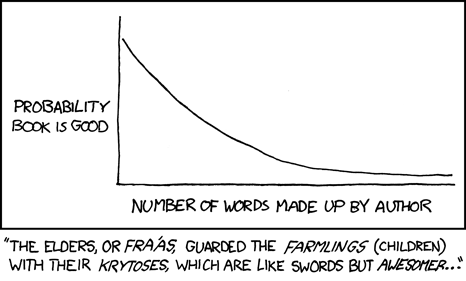
The comic is either dissing Anathem, or warning it, not sure which. If you go to the xkcd website and mouse over the image, the text that pops up says “Except for anything by Lewis Carroll or Tolkien, you get five made-up words per story. I’m looking at you, Anathem.”

So, we know to discredit this particular comment because a) he allows an exception for Tolkien, who is boring, and b) he’s dissin’ Stephenson. Or threatening Stephenson that the novel better not suck whenever the comic artist gets around to reading it. Not sure which.

Regardless, I actually agree with the Rule of Thumb, I would just replace Tolkien with Stephenson in his list of exceptions. I’m indifferent on Lewis Carroll. (If you’d like to debate exceptions, I direct you to the xkcd forum, where there’s somthing like 10 jillion posts about this comic debating that very topic).

I had trepidations when I read a blurb about Anathem when it first came out. Too many speculative fiction books “create” a world by just making up different names for stuff, and Stephenson makes up a hell of a lot of words in the blurb alone.

But, as another commenter put it, the first part of the book is a pretty impressive bit of world building. It only took a few pages before the multitudes of made-up words clicked and I stopped noticing them or caring.

As to the ending, to be perfectly honest I’m going to liken it to watching the movie Primer, a low budget but extremely good time travel movie1. I really enjoyed it, but I was hanging onto comprehension by my fingernails. I may need to go back and read the last 100 pages again, just to make sure I followed what happened correctly. In my own defense, I was really into it at this point and taking every opportunity to read a few pages. So I’d get it in little 5 page bursts, interrupted by a kid or dog or kid-dog related emergency. Theoretically, I should have just waited until I had a block of time, but… you know, Stephenson. I’m a fan.

I would bet $1,000 that Stephenson has read Walter M. Miller’s A Canticle for Leibowitz.

Some folks are saying that Anathem is better than Cryptonomicon. My vote is still with Cryptonomicon and, for that matter, The Baroque Cycle trilogy. But Anathem is a close second (fifth?), and tied with The Diamond Age: Or, a Young Lady’s Illustrated Primer, and just ahead of Snow Crash.

Glad I could clear that up for everybody.
____________
1 Which is not to say that Anathem is a book about time travel. I’m not saying what it’s about. This log is spoiler free, more or less. I’m just saying that what it’s about is complex, like time travel narratives can be.

Book Log – Electricity: A Novel

Electricity: A Novel by Victoria Glendinning

Fooled, I was, by the title and cover of this book. I envisioned it as a Difference Engine/Baroque Cycle Trilogy bit of historical fiction with a female protagonist. Really, it’s a Romance novel that half-heartedly uses electricity as metaphor.

To be sure, there’s some presumably well-researched realism in the early days of electricity as the husband of our lovely protagonist is an electrical engineer hired to electrify the manor of a handsome, rich gentleman. You can guess where that’s going.

I read the first two-thirds in fits and spurts, then set it aside for months and months when more attractive fare appeared on my bookshelf. The last third has almost nothing to do with electricity, and instead delves into the mystic/medium scene for a while.

Ho hum.

It is small and portable (fits in my obligatory factory lab coat), so I threw it in the bag for my trip to Juarez to knock it out in my many, many spare moments I have here. And thus I have.