I never have, and I never thought I would say this, but…
I am excited about the new Star Trek movie.

I never have, and I never thought I would say this, but…
I am excited about the new Star Trek movie.
Reddit had this link:
Marriages for none, civil unions for all.
That’s some conservativeness I can get behind. It neatly solves the professed problem of keeping “marriage” “sacred”.
I’ve stated elsewhere that I think there should be as many types of legal civil unions as there are legal corporate organizations. You can form an S or C corp, an LLP, LLC, or a sole proprietorship, but you’ve only got one (possibly two in some states) types of civil contracts.
So, whoever’s in charge of that… make that happen, okay? Thanks.
The Code Book by Simon Singh
This is another book that I put on my paperbackswap wish list and promptly forgot why. But the wish list did not fail me, as I found it a very enjoyable read. Essentially this book is a description of the evolution of cryptography from ancient times to the present, and projections into the future. I had steeled myself for a rather academic read, but found it not a dry recitation of crypto methodology, but rather interesting information artfully intertwined and backed up with real stories where cryptography and cryptanalysis have played a major, sometimes life or death, role.
As I was reading it, I noticed a lot of stories and events that were integral to the book Cryptonomicon. In fact, I think that a WWII event mentioned in The Code Book was fictionalized as a faked event in Cryptonomicon… I want to check that out.
Also, Cryptonomicon gets its name from a non-existent bible of cryptography said to have been created a long time ago and added to over the decades. In The Code Book, it is said that Charles Babbage started work on such a book in the early 1800’s, but got distracted and never finished it. I’m wondering if Stephenson hypothesized that Babbage or a successor finished that book. I need to go back and check.
All of which is to say that I would not have been the least surprised if Stephenson had read The Code Book, except for the fact that both books were published in the same year (1999). Then again, if two people are researching cryptography, it’s fairly likely they’ll get the same data.
One neat bit is that at the end of The Code Book the author presents a contest (for prize money) that was to end in 2010, a series of 10 progressively difficult cryptographic puzzles. The solutions to all 10 were found by some Swedish scientists in 13 months.
I have dabbled in some low grade cryptanalysis, so I may try my hand at level 1 and 2 at some point. When I have a bunch of free time. By which I mean, never.
I’ve heard arguments back and forth as to who won the final presidential debate last night. I’m surprised the pundits are overlooking my obviously superior performance.
I did not once go negative all evening. Not even when steakums asked me to walk the dog before going to bed.
I never once claimed that No Child Left Behind was “the first time we had looked at the issue of education in America from a nationwide perspective.” Because I’m pretty sure we have a federal Department of Education that looks at the issue of education in America from a nationwide perspective at least once a day. Maybe twice if they take a short lunch.
I remained poised, confident and relaxed at all times. Also, I had graham crackers.
William Ayers does not live anywhere near my neighborhood, though in the interest of full disclosure, there are some domestic terrorists who occasionally egg my car. To my knowledge, they have never had a meet-and-greet for me in their home.
I did not once reference Joe the Plumber.
I represented myself as a family man by cleaning up the cups of Play-Doh my daughter left lying around.
When asked a question, I answered directly without talking around the issue. “Will you walk the dog before going to bed?” Yes, yes I most certainly will, without precondition.
FactCheck.org has found no misrepresentations in any of my statements.
I have shown bipartisanship throughout much of my life by wearing blue shoelaces on one foot, and red on the other.
Yes, my friends, I think I’ve got this one sewn up.
Trouble on Triton by Samuel R. Delany
I didn’t really understand the point of this book. Aside from being a speculative fiction concerned with creating a possible future (published in 1976), there’s some kind of point he’s making about gender roles, but I’ve really got no idea what that point is.
The blurb on the back says “…Bron Helstrom– an immigrant to the embattled world of Triton, whose troubles become more and more complex, till there is nothing left for him to do but become a woman.” It doesn’t make any more sense when you read it. Something about how he is a certain rare kind of man (as far as I can understand, a “jerk”), and that type of person is even more rare in women, and in order to save the human race he needs to change genders and find a man like himself in order to be happy. Or something like that. I dunno. Also, there’s some sort of war going on between Earth and the outer planets. And men and women are the same height because we stop discriminating in the 21st Century.
It’s not as big a deal to switch genders in this future because it takes about 3 and a half hours, including physical changes, changing your Y chromosome to X and reversing your sexual orientation (if desired).
I was tempted multiple times to abandon the book, but just about then I’d come into an interesting passage about genetics or something similar, and that’d give me some more momentum.
Like all Science Fiction of past decades, it’s amusing to see where the authors get it (likely) wrong and where they get it right. In the wrong case, he assumes that data is still stored on “tape” in 2112, on the other hand he predicts that the human genome will be sequenced in the early 21st century.
Of course, maybe they will store data on some sort of super-Tape in the future. What do I know?
Anathem by Neal Stephenson
In the beginning of this novel, there is a Note to the Reader, the first line of which is:
“If you are accustomed to reading works of speculative fiction and enjoy puzzling things out on your own, skip this Note.”
So I did. And my first recommendation to anyone thinking of reading this book is to learn as little as you can about it, including skipping that note.
The second recommendation to anyone thinking of reading this book is to ignore this xkcd comic:
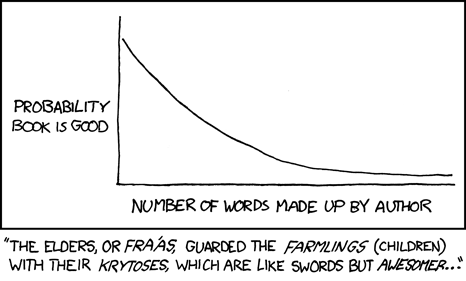
The comic is either dissing Anathem, or warning it, not sure which. If you go to the xkcd website and mouse over the image, the text that pops up says “Except for anything by Lewis Carroll or Tolkien, you get five made-up words per story. I’m looking at you, Anathem.”
So, we know to discredit this particular comment because a) he allows an exception for Tolkien, who is boring, and b) he’s dissin’ Stephenson. Or threatening Stephenson that the novel better not suck whenever the comic artist gets around to reading it. Not sure which.
Regardless, I actually agree with the Rule of Thumb, I would just replace Tolkien with Stephenson in his list of exceptions. I’m indifferent on Lewis Carroll. (If you’d like to debate exceptions, I direct you to the xkcd forum, where there’s somthing like 10 jillion posts about this comic debating that very topic).
I had trepidations when I read a blurb about Anathem when it first came out. Too many speculative fiction books “create” a world by just making up different names for stuff, and Stephenson makes up a hell of a lot of words in the blurb alone.
But, as another commenter put it, the first part of the book is a pretty impressive bit of world building. It only took a few pages before the multitudes of made-up words clicked and I stopped noticing them or caring.
As to the ending, to be perfectly honest I’m going to liken it to watching the movie Primer, a low budget but extremely good time travel movie1. I really enjoyed it, but I was hanging onto comprehension by my fingernails. I may need to go back and read the last 100 pages again, just to make sure I followed what happened correctly. In my own defense, I was really into it at this point and taking every opportunity to read a few pages. So I’d get it in little 5 page bursts, interrupted by a kid or dog or kid-dog related emergency. Theoretically, I should have just waited until I had a block of time, but… you know, Stephenson. I’m a fan.
I would bet $1,000 that Stephenson has read Walter M. Miller’s A Canticle for Leibowitz.
Some folks are saying that Anathem is better than Cryptonomicon. My vote is still with Cryptonomicon and, for that matter, The Baroque Cycle trilogy. But Anathem is a close second (fifth?), and tied with The Diamond Age: Or, a Young Lady’s Illustrated Primer, and just ahead of Snow Crash.
Glad I could clear that up for everybody.
____________
1 Which is not to say that Anathem is a book about time travel. I’m not saying what it’s about. This log is spoiler free, more or less. I’m just saying that what it’s about is complex, like time travel narratives can be.
Bear Stearns, the Macs, AIG… all were Too Big To Let Fail.
So, the question that has been bouncing about in my brain for a few months now is… if they’re Too Big To Fail, are they just Too Big?
I’m a fan of capitalism. I think that Adam Smith’s Invisible Hand is a primarily benevolent force. But I also believe that time and time again, Scale Matters.
You shouldn’t fear that radiation will cause a preying mantis to grow to 50 feet tall and begin smashing buildings, because Scale Matters, and the exoskeleton structure just doesn’t work at those sizes.
I was going to say something about spider-web (strongest natural fiber in the world) not scaling up, but maybe it will.
Wal-Mart succeeds so spectacularly because Scale Matters.
So… does Smith’s Invisible Hand formula become unstable when certain elements producing the Hand become oversized?
I feel like some mathematics need to be brought to bear on these large companies. When the numbers get large enough to threaten systemic failure, does the Hand need a nudge from regulation? In addition to Monopoly laws, do we need Size laws?
Size Laws would be complicated to be sure. A Bear Stearns-type failure might be more “impactful” than a WalMart-type failure, even if they had comparable sums of money involved.
Or is the press just Chicken Little-ing because folks who report on P/E ratios all day long are hungry for the Big Story? Is the government stepping in and preventing a severe but manageable correction (handleable by the Hand) to prevent folks from panicking in an election year?
I don’t have enough data to form a confident opinion. But it seems on the face that Too Big To Fail is To Big To Be.
For those of you who don’t know, I do a show at a local theater in Atlanta (Dad’s Garage Theater) called Uncle Grampa’s Hoo-Dilly Storytime.
The premise is that a monkey, a robot, a man in lederhosen, their butler and a guest character1 all get together in the Hoo Dilly house2 to act out an improvised story for the kids, with copious amounts of audience participation. The title for the episode’s story is taken from a spinning wheel with four potential titles on it. A kid spins the wheel, so if the story doesn’t work out, it is that child’s fault. Or so we say backstage.
We usually make up the titles in the green room before the show. But one of the cast members, in preparation for our opening on September 27, started throwing out title ideas via email, and I responded with same:
Sneakers The Crime Solving Dog
Once Upon A Time in Cleveland
The Princess and the Peanut
Ol’ Uncle Crabby Gets a Unicorn
Mouse Trouble
Once Upon a Time In Space
Oh no, it’s Vikings!
Bizz Buzz in Hive Five!
The Hopscotch Bandits
The Princess of Candy
The Super Duper Spies and the Mystery of The Whatzitcalledagain
Four Days Before Christmas
The Snow Day and the Yeti
Pony Loses His Saddle
Monster School
Disaster! The Musical
Got any ideas? Put ’em in the comments.
_______________
1 New to the cast this year will be a donkey and a duck.
2 Left to the man in lederhosen by his Uncle Grampa, who is played by a former president of the United States.
Electricity: A Novel by Victoria Glendinning
Fooled, I was, by the title and cover of this book. I envisioned it as a Difference Engine/Baroque Cycle Trilogy bit of historical fiction with a female protagonist. Really, it’s a Romance novel that half-heartedly uses electricity as metaphor.
To be sure, there’s some presumably well-researched realism in the early days of electricity as the husband of our lovely protagonist is an electrical engineer hired to electrify the manor of a handsome, rich gentleman. You can guess where that’s going.
I read the first two-thirds in fits and spurts, then set it aside for months and months when more attractive fare appeared on my bookshelf. The last third has almost nothing to do with electricity, and instead delves into the mystic/medium scene for a while.
Ho hum.
It is small and portable (fits in my obligatory factory lab coat), so I threw it in the bag for my trip to Juarez to knock it out in my many, many spare moments I have here. And thus I have.
Dear Wired,
Had Wired been around when Alexander Graham Bell asked Watson to join him from the other room via electrical current, would you have called it a flop because the sound quality was poor and he should have read Shakespeare instead?
Give Esquire a break. An E-Ink cover is brutally cool, regardless of the simplicity of the animation.
My guess? Either you’re in a snit because you, the technology magazine, didn’t do it first, or you’re bitter that you can’t get dates with the people who write for Esquire.
Just sayin’.
Regards,
ElectricRocket
________
ETA: Now THIS is the future. A flat sheet of plastic that is a book, or a newspaper, or a magazine, or whatever. Screw the Amazon Kindle.